Computer-Supported Engineering Design Pedagogy
Collaborate — Conceptualize — Create
An intelligent collaborative design laboratory guiding engineering students and teams from open-ended problem exploration to rigorous, multi-perspective conceptual architectures.
PROLIFIC_LAB_CANVAS // ACTIVE_SESSION_ENGINEERING_01
Cognitive Divergence: Optimal
6 Guided Modules Active

Design Space Map
24 Concepts Interlinked
Explicit semantic linkages preventing premature design fixation
Pedagogy Scaffolding
Target & Purpose Engine
Automated real-time prompts & guided Navigator unlocking
Active Cognitive Triggers:
7
SCAMPER Operators
Systematic lateral manipulation
100%
Semantic Graphing
Every node meaningfully connected
N × M
Morphological Space
Combinatorial means synthesis
360°
Perspective Taking
Multi-stakeholder design framing
Six Rigorous Engineering Design Modules
Each module provides specialized cognitive scaffolding, systematically unlocking as students fulfill pedagogical criteria.
Design Space Map (DSM)
Semantic Knowledge Graph
Team SCAMPER Studio
Lateral Ideation Engine
Perspective Taking & Spotlight
Multi-Stakeholder Framing
Functional Decomposition (Juxtaposer)
System Architecture
Morphological Analysis
Combinatorial Synthesis Matrix
Intelligent Studio Navigator
Metacognitive Scaffolding
Active Curriculum Module
Design Space Map (DSM)
A non-linear graph canvas connecting engineering challenges, constraints, obstacle nodes, and candidate ideas with explicit semantic link phrases.
Pedagogical Objective & Cognitive Role
Prevents premature cognitive convergence and fixation by enabling teams to continuously expand the design boundary before committing to physical configurations.
Key Interactive Features:
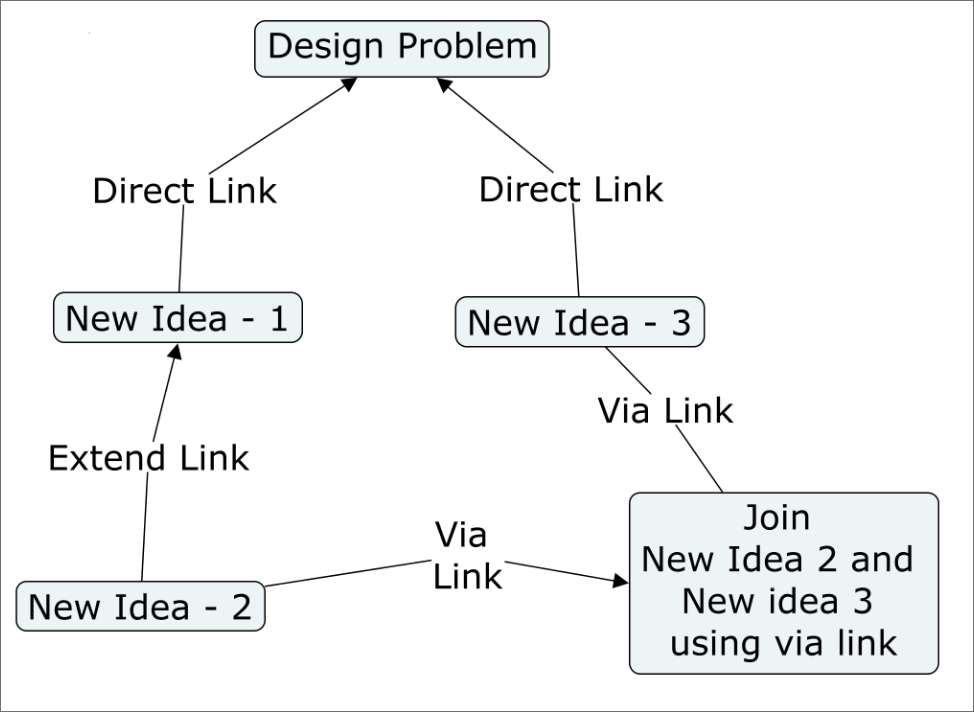
The 6-Stage Engineering Conceptualization Workflow
How student design teams progress through iterative divergent ideation, relational modeling, and convergent morphological synthesis.
01
Phase 1Problem Formulation & Brainstorming
Divergent Ideation
Teams engage with realistic engineering scenarios, capture initial intuitive responses, and post candidate concepts onto the collaborative canvas.
02
Phase 2Design Space Mapping & Relational Linking
Structured Knowledge Modeling
Concepts are organized into an interconnected graph with explicit relational link phrases (causes, constrains, requires, extends).
03
Phase 3Multi-Category Taxonomic Clustering
Landscape Segmentation
Students generate custom taxonomies to cluster ideas, revealing unpopulated voids and overlooked physical domains.
04
Phase 4Team SCAMPER Feature Transformation
Systematic Lateral Innovation
Concepts are visually deconstructed into constituent parts and transformed using the 7 SCAMPER action verbs.
05
Phase 5Perspective Taking & Spotlight Framing
Stakeholder Multi-Perspective
Teams evaluate the design space through contrasting operational lenses: user interaction, manufacturability, efficiency, and cost.
06
Phase 6Functional Decomposition & Morphological Matrix
Rigorous Conceptual Architecture
Functions are decomposed and paired with multiple physical means in a morphological matrix to generate fully realized conceptual designs.
Guided Engineering Video Curriculum
In-depth video tutorials authored to guide design students and instructors through each stage of the Prolific Designer system.
Open on YouTube
Engineering Product Design & Prolific Designer
A comprehensive walkthrough of the Prolific Designer pedagogy, showing how design teams formulate fuzzy problems, explore multi-dimensional design spaces, and arrive at systematic conceptual architectures.
Core Learning Outcomes:
Understand the computer-supported collaborative design cycle
Transition from open-ended problem exploration to structured ideation
Overcome early cognitive fixation in engineering teams
Curriculum Playlist (4 Modules)
Engineering Product Design & Prolific Designer
Core Overview
• Overview Tour
Creating the Design Space Map (DSM)
Activity 1
• Interactive Mapping
Ideating via Team SCAMPER
Activity 2
• Structured Ideation
Categorizing the Design Space Map
Activity 3
• Taxonomic Clustering
Academic Pedagogical Research
Prolific Designer's curriculum has been deployed across engineering design courses to scaffold creative collaboration, study design cognition, and systematically evaluate student concept quality.
Designed for Both Engineering Teams & Instructors
Whether participating in active design sprints or orchestrating studio curriculum, Prolific Designer equips everyone with dedicated toolsets.
Engineering Student Experience
Work collaboratively with teammates in real-time. Navigate design activities with guided hints, structured goal checklists, and immediate feedback.
Join active studio sessions with instant keyword codes
Interactive GoJS graphical design space mapping
Target & Purpose checklists guiding every activity
Morphological matrix conceptual formulation
Facilitator & Instructor Console
Author real-world design challenges, manage studio breakout groups, observe student team progression, and review interaction telemetry for pedagogical assessment.
Author custom scenarios, problem constraints, and starter ideas
Monitor multi-team progress and activity completion gates
Detailed cognitive interaction logging and research exports
Session administration and keyword redistribution
Target & Purpose: Metacognitive Guidance
Engineering design requires both action and reflection. Prolific Designer embeds dual metacognitive scaffolds into every activity:
Activity Target Checklist
Actionable milestones ensuring teams exhaustively explore links, categories, and sub-functions before moving forward.
Activity Purpose Rationale
Explicit cognitive rationale explaining why the activity is critical in the engineering lifecycle and how it benefits downstream decisions.
Design Space Map Goals
Make meaningful relational links between candidate concepts
Maximize meaningful interconnections to reveal latent constraints
Ensure every node has at least one explicit relationship phrase
Evaluate whether current ideas can formulate a complete product
Pedagogical Purpose:
"Creating a comprehensive and well-connected design space map allows teams to identify cause-effect, influencers, range, and limitations—building the knowledge foundation needed for sound engineering decisions."
Ready to Transform Your Conceptual Engineering Process?
Join hundreds of engineering students and instructors utilizing Prolific Designer to structure complex design spaces and generate breakthrough product concepts.